


Introduction
The risk management framework and internal control system are designed to identify, evaluate and manage risks that could impede the achievement of the business objectives and strategies.
Board Responsibilities
The Board affirms its overall responsibility in maintaining a sound risk management and internal control system at HSG Berhad “HSG” to safeguard the interest of shareholders, customers, employees and the Group’s assets.
In view of the limitations inherent in any system of risk management and internal control, the system is designed to manage, rather than to eliminate, the risk of failure to achieve the policies, goals and objectives of the Group. Therefore, it can only provide reasonable, rather than absolute assurance against material misstatement of management and financial information, financial losses, fraud and breaches of laws or regulations.
Control Environment and Activities
I. Risk Management Framework
HSG’s risk management process encompasses identifying the Group’s key risks and providing reasonable assurance in managing the risks within its risk appetite. The aim is to set clear guidelines to the level of risks acceptable to the Group.
The Risk Management Framework adopts a top-down approach to identify the Group’s key risks and a bottom-up approach to identify operational risks.
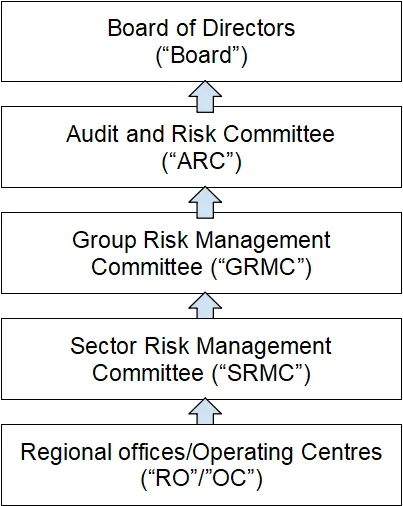
The Board is supported by the Group Risk Management Committee (“GRMC”), headed by the Chief Executive Officer (“CEO”) in overseeing the risk management efforts within the Group. In line with the Group’s stance to promote a robust risk management process, risks reported by the Regional Offices/Operating Centres (“RO/OC”) are deliberated by the respective business divisions’ Sector Risk Management Committees (“SRMC”) prior to escalating to the GRMC to ensure they are aligned with the Group’s strategic objectives and overall risk appetite. The GRMC deliberates on the key risks and performs deep-dive reviews on strategic topics before reporting to the Audit and Risk Committee (“ARC”) and Board of Directors (“Board”) twice a year. Any changes highlighted by them would be cascaded to the RO/OC for remedial actions. Notwithstanding the above, any emerging principal risks that may arise during the year will be escalated immediately to the GRMC for evaluation and review.
The above process is coordinated by the Risk Management Unit, led by the Enterprise Risk Manager in conjunction with the SRMC, for periodic reporting to the GRMC, the ARC and the Board.
The Group’s risk management framework is set out in the diagram below:
The principal risks for the financial year 2023 reviewed by the Board of Directors are as follows:
(a) Sustainability Risks
Sustainability is strongly upheld in HSG’s businesses and operations and plays an important role in ensuring long-term business resilience and growth. The Group’s key stakeholders namely customers, suppliers, principals, regulators, financiers and investors have greater expectations and demands on sustainability matters. The sustainability governance in HSG is led by the Board, assisted by the ARC.
(i) Human Rights Risk
HSG is firmly committed to upholding human rights and ensuring fair treatment for all its employees. As part of this commitment, the Group has implemented a “no recruitment fee” policy. This policy ensures that foreign workers are not burdened with recruitment-related fees at any stage of the hiring process, reflecting HSG’s dedication to ethical recruitment practices.
Furthermore, HSG places the highest priority on the health and safety of its workers. The company diligently maintains safe and healthy working and living conditions across all its workshop branches, especially for mechanics. This commitment underscores HSG’s responsibility to safeguard the well-being of its workforce and uphold the highest standards of occupational health and safety.
(ii) Climate Change Risk
HSG recognizes climate change as both a risk and a responsibility to manage. As the Malaysian government has recently mandated that all diesel fuels for commercial and passenger vehicles be compliant with Euro 5 specifications as part of its efforts to reduce pollution and encourage the consumption of cleaner fuels, HSG has taken the step to align its operations with these standards.
While continuing to supply Euro 2 and Euro 3 trucks and machinery to meet the diverse needs of customers, HSG is now introducing Euro 5-compliant trucks and machinery as an addition to its product lineup. This initiative ensures that the company can meet the market demand for cleaner and more environmentally friendly vehicles. By offering Euro 5 trucks and machinery equipped with advanced emission control technologies, HSG significantly reduces harmful pollutants and supports the government’s environmental goals.
The Malaysian government is also providing benefits, such as reduced road tax, for vehicles that comply with Euro 5 standards. By offering these compliant vehicles, HSG enables customers to take advantage of these incentives while contributing to a cleaner environment.
Through this commitment, HSG not only complies with national regulations but also provides customers with the option to choose cleaner transportation and machinery solutions. This strategic move allows the company to cater to a broader market while contributing to a healthier environment and promoting sustainable development. HSG’s dedication to corporate social responsibility and environmental stewardship remains at the forefront of its business practices.
(iii) Supply Chain Risk
HSG is dedicated to ensuring that its supply chain adheres to the highest standards of integrity and responsibility. As part of this commitment, the Company actively manages risks associated with its international and local suppliers, including those involved in the provision of new and rebuilt trucks. HSG emphasizes rigorous supplier selection processes and ongoing monitoring to uphold quality and compliance throughout the supply chain.
The Company prioritizes transparency and accountability in all aspects of its operations. HSG collaborates closely with its suppliers to ensure adherence to ethical practices, including fair labor standards and environmental sustainability. By maintaining robust oversight and engaging in continuous dialogue with suppliers, HSG aims to mitigate potential risks and foster a responsible and resilient supply chain.
(b) Market and Commodity Risks
HSG acknowledges the inherent market and commodity risks associated with its operations in the truck and machinery industry. The Company is committed to proactively identifying, assessing, and managing these risks to ensure business stability and continuity.
Market Risk: HSG recognizes that fluctuations in market demand, changes in economic conditions, and shifts in consumer preferences can impact the Company’s sales and profitability. To mitigate these risks, HSG employs strategic market analysis, diversifies its product offerings, and continuously adapts its marketing and sales strategies to align with evolving market trends. The Company also fosters strong relationships with key customers and stakeholders to enhance market resilience and responsiveness.
Commodity Risk: The Company is aware of the volatility in the prices of key commodities and raw materials used in the production and assembly of trucks and machinery. To manage commodity risk, HSG implements effective procurement strategies, engages in long-term supply contracts where feasible, and explores alternative sourcing options. By monitoring commodity price trends and leveraging strategic partnerships, HSG aims to minimize cost fluctuations and ensure a stable supply of essential materials.
Through these measures, HSG strives to safeguard its operations from market and commodity uncertainties, thereby supporting its long-term growth and operational efficiency.
(c) Production Cost Risks
The risks in production cost management include fluctuations in raw material prices, labor costs, and operational expenses. Variability in the prices of components and materials can impact overall production costs, especially when sourcing from multiple suppliers. In addition, labor costs, including wages and benefits, can be unpredictable and subject to changes in labor laws and market conditions.
(d) Currency Fluctuation Risks
Currency fluctuations represent a significant financial risk for HSG due to its international trade activities. As the company imports goods and sources materials globally, changes in exchange rates between the Malaysian Ringgit (MYR) and foreign currencies can affect costs and profitability. A depreciation of the MYR increases import costs, potentially squeezing profit margins if these costs cannot be passed on to customers. Conversely, an appreciation of the MYR can reduce import costs but might impact pricing competitiveness.
HSG actively manages currency fluctuations through hedging strategies. By employing financial instruments such as forward contracts and options, the company mitigates the risks associated with fluctuations in exchange rates. This proactive approach helps stabilize costs, protect profit margins, and ensure more predictable financial outcomes, despite the inherent volatility of international currency markets.
(e) Investment Risks
Investment risk for HSG includes the potential for financial loss or diminished returns due to factors such as market volatility, economic fluctuations, and changes in industry conditions. To manage these risks, the company engages in thorough due diligence and assessment of investment opportunities. Each investment is evaluated for its alignment with HSG’s strategic goals and overall financial stability.
Additionally, HSG employs a diversification strategy to mitigate investment risk. By spreading investments across different sectors and projects, the company reduces its dependence on any single asset and lessens its exposure to adverse market movements. This approach not only safeguards HSG’s capital but also aims to deliver stable, long-term returns, supporting sustained business growth and resilience.
Other Elements of Risk Management and Internal Control
Board Meetings
At a minimum, the Board meets on a quarterly basis and has a formal agenda on matters for discussion. The CEO leads the presentation of board papers and provides explanation on pertinent issues. A thorough deliberation and discussion by the Board is a prerequisite before arriving at any decision. In addition, the Board is kept updated on the Group’s activities and operations on a timely and regular basis.
Organizational Structure with Formally Defined Responsibility Lines and Delegation of Authority
HSG has in place an organizational structure with formally defined responsibility lines and authorities to facilitate quick response to changes in the evolving business environment, effective supervision of day-to-day business conduct and accountability for operation performance. Capital and non-capital expenditures and acquisition and disposal of investment interest are subject to appropriate approval processes. The limit of authorities for approval levels is established for budgeted and non-budgeted capital expenditure.
Performance Management Framework
Management reports are generated on a monthly and consistent basis to facilitate the Board and the Group’s Management in performing financial and operation reviews on the various operating units. The reviews encompass areas such as financial and non-financial key performance indicators, variances between budget and operation results and compliance with laws and regulations. The Group has in place a well-controlled budgeting process that provides a responsible accounting framework. The Group’s annual budget is approved by the Board prior to implementation.
Operational Policies and Procedures
Documented policies and procedures form an integral part of the internal control systems to safeguard shareholders’ investment and the Group’s assets against material losses and ensure complete and accurate financial information. These documents consist of approved memoranda, circulars, manuals and handbooks that are continuously being revised and updated to meet operational needs.
Whistleblowing Policy
A Whistleblowing Policy is in place to provide clarity of oversight of the whistleblowing process, protection and confidentiality to whistleblowers. The policy sets out a protocol for employees and stakeholders to raise genuine possibilities of improprieties, malpractices and misconduct within the Group for remedial action. In addition, the Employee Grievance Redressal Policy is in place to provide a clear and transparent framework for employees to raise any grievances without fear of retaliation. The policy is available on the Company’s website at (_______________)
Integrity and Anti-Corruption
As a responsible corporation, the Group is committed to doing business with integrity. The employees and associated persons are guided by the Group’s Anti-Corruption Policy to act professionally, fairly and with integrity in all business dealings and relationships. The Group Donations and Sponsorships Policy, and Guidelines on Gifts, Benefits and Hospitality are in place as testimony of the Group’s commitment to conduct business in an honest and ethical manner.
The Group’s ABAC Committee oversees the Group’s ABAC programmes and reports to the BOD, the ARC and the Board. The ABAC Committee meets regularly to review the effectiveness of ABAC controls and compliance matters. The Board is kept abreast of the Group’s anti-corruption initiatives and compliance programmes via periodic reporting. In this respect, the Internal Audit Division has undertaken to perform a periodic review on the effectiveness of the Group’s ABAC programmes, whistleblowing framework, and its state of compliance in the financial year (____). For the coming year, the Group’s ABAC Committee will continue to drive and reinforce ABAC awareness amongst employees within the Group.
Where applicable, the requirements of the Group’s existing policies, systems and procedures in relation to anti-bribery and anti-corruption are extended to the Group’s agents, counterparties and business partners to ensure that anti-corruption and bribery initiatives are applied throughout the Group’s supply chain. The Group will continue to foster an anti-corruption culture and adhere to the anti-corruption laws and regulations in countries in which it operates.
The Group’s stance in combating corruption is publicly available on the Company’s website at (________), via the Group Anti-Corruption Policy together with the Group’s Codes of Conduct and Ethics, Sustainability Policy and other relevant policies and procedures.
Group Internal Audit
The Internal Audit Division, which reports directly to the Audit and Risk Committee, conducts reviews on the system of internal controls and the effectiveness of the processes that are in place to identify, evaluate, manage and report risks. Their audit practices are guided by Professional Internal Auditing Standards as prescribed by the Institute of Internal Auditors, Malaysia. Routine reviews are conducted on units under the Group’s major core activities. Appropriate recommendations are made to address the issues and weaknesses highlighted and they are subsequently followed up to ensure proper implementation.
Review of Statement by External Auditors
The External Auditors have reviewed this Statement pursuant to the scope set out in the Audit and Assurance Practice Guide (“AAPG”) 3, Guidance for Auditors on Engagements to Report on Statement on Risk Management and Internal Control issued by the Malaysian Institute of Accountants for inclusion in the Annual Report of the Group for the year ended (_______), and reported to the Board that nothing has come to their attention that caused them to believe that the Statement intended to be included in the Annual Report of the Group, in all material aspects:
(a) has not been prepared in accordance with the disclosures required by paragraphs 41 and 42 of the Statement on Risk Management and Internal Control: Guidelines for Directors of Listed Issuers; or
(b) is factually inaccurate.
AAPG 3 does not require the External Auditors to consider whether the Directors’ Statement on Risk Management and Internal Control covers all risks and controls, or to form an opinion on the adequacy and effectiveness of the Group’s risk management and internal control system including the assessment and opinion by the Board and Management thereon. The Auditors are also not required to consider whether the processes described to deal with material internal control aspects of any significant problems disclosed in the Annual Report will, in fact, remedy the problems.
Conclusion
The Board has reviewed the adequacy and effectiveness of the Group’s risk management and internal control system for the year under review and up to the date of approval of this Statement for inclusion in the Annual Report. They are of the view that the risk management and internal control system is satisfactory and there were no material losses incurred during the year under review as a result of internal control weakness or adverse compliance events.
For the period under review, the CEO and Group Chief Financial Officer have provided assurance to the Board that the Group’s risk management and internal control system is operating adequately and effectively, in all material aspects.
This Statement was approved by the Board of Directors on (_________________)